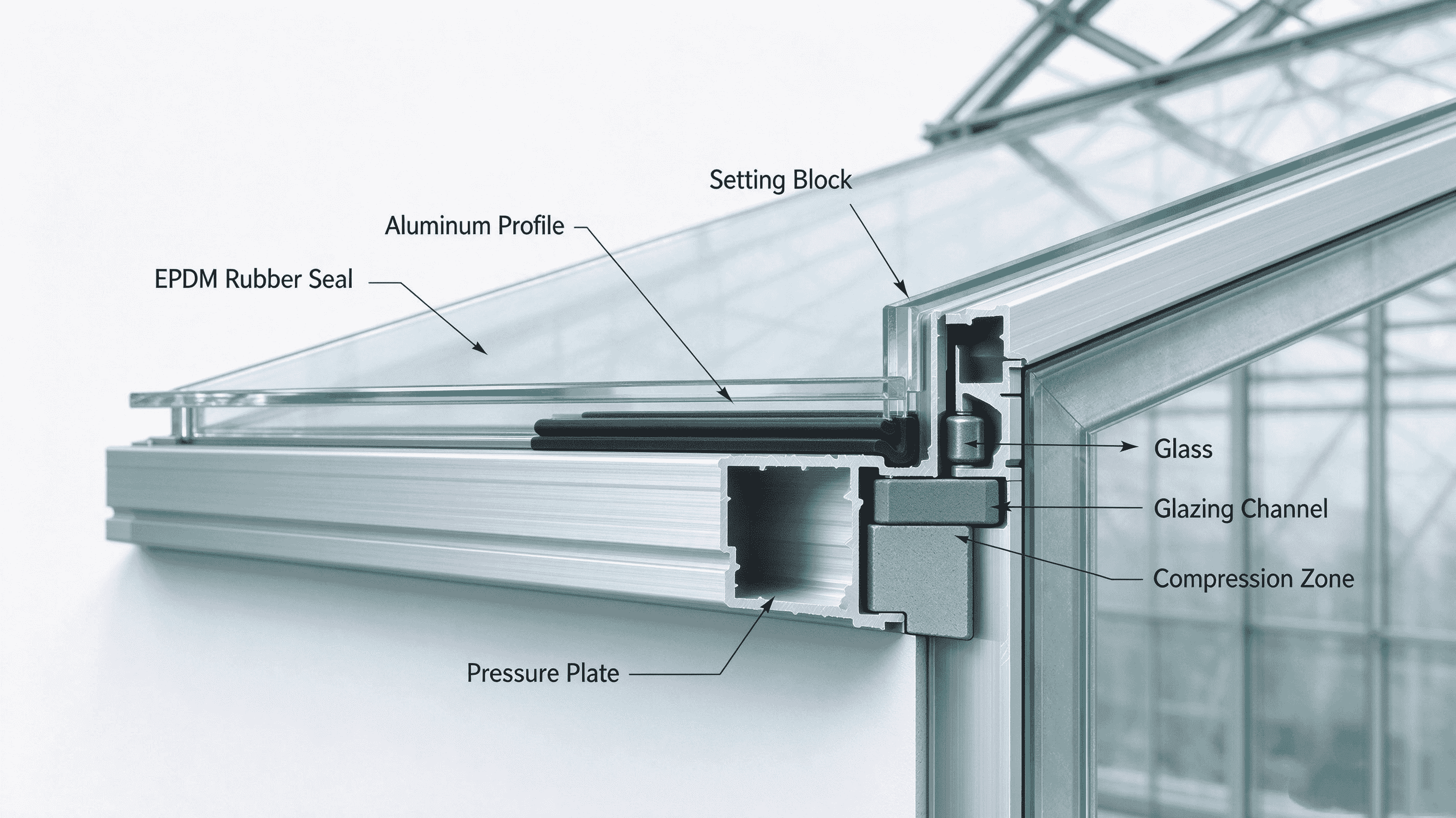
A high-performance commercial greenhouse relies on an integrated glazing system where glass, aluminum framing profiles and EPDM rubber seals work in precise harmony. Correctly specified and installed, this three-part assembly delivers long-term weathertightness, thermal efficiency and structural reliability. When mismatched, even premium glass can leak, crack or underperform prematurely.
This guide explains how these components interact at the interface level, why tight dimensional tolerances are critical, and how proper installation preserves system performance over time.
Each element in the glazing assembly has a distinct function, and none can fully compensate for shortcomings in another.
As the primary light-transmitting element of the greenhouse envelope, tempered horticultural glass delivers consistent optical performance and impact resistance. Its thickness uniformity, edge quality and dimensional precision directly affect seating in the frame and even gasket compression.
Aluminum profiles form the structural skeleton that holds glass panels in place. Channel width, depth and retaining lip dimensions define the gap for glass and gaskets, setting the baseline for the full tolerance stack.
Positioned between glass and aluminum, EPDM gaskets serve three key purposes: weather sealing against air and water ingress, cushioning to prevent metal-to-glass contact and stress cracks, and flexibility to absorb thermal expansion and structural movement. EPDM is the industry standard for greenhouses thanks to its UV resistance and long-term compression stability.
Most glazing failures stem not from a single faulty part, but from tolerance stack-up — small deviations across components that accumulate into significant fit issues.
Glass panes must rest evenly in the aluminum channel on properly placed setting blocks. Mismatched thickness causes either over-compressed gaskets (premature ageing, displacement) or insufficient compression (leaks, drafts). Clean, uniform edges support full perimeter gasket contact; chipped edges create gaps and localised stress.
Every manufactured component has a tolerance range. Standard tempered glass typically has a thickness tolerance of up to ±0.3 mm; aluminum channels around ±0.7 mm; and gaskets carry their own variation. In worst-case scenarios, cumulative mismatch can completely compromise the seal.
At Yuhua Glass, our horticultural greenhouse glass is produced to controlled tolerances: ±0.2 mm for 4 mm glass and ±0.3 mm for 5 mm glass, aligned with premium commercial glazing standards. This consistency reduces stack-up risk, ensures predictable gasket compression across every pane, and delivers uniform fitting performance — especially critical on 20+ hectare projects with thousands of panels.
These interface and tolerance checks form a key early stage of every glazing project. Explore our complete greenhouse glass supply workflow from drawings to shipment to see our full order process.
Proper EPDM gasket compression creates a continuous weather barrier. Under-compression causes leaks; over-compression leads to permanent deformation and early failure. Gasket profiles must be matched to the actual gap, not just nominal dimensions.
Greenhouse glazing experiences constant temperature swings. Glass and aluminum expand and contract at different rates as temperatures rise and fall.
Without room for this differential movement, stress builds at glass edges, leading to cracks, broken panes and dislodged gaskets over time. The rubber seal is the critical component that absorbs this movement while maintaining compression. Wind load and frame deflection add further micro-movement, which a well-specified gasket accommodates without breaking the weather seal.
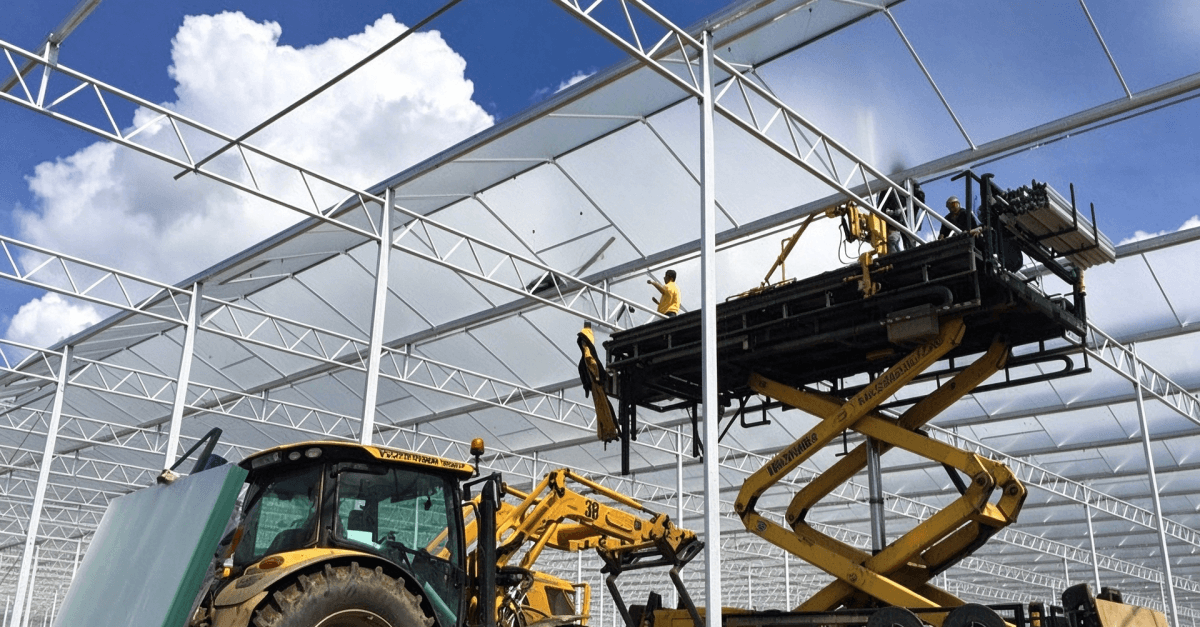
Even well-specified components underperform with poor installation. The three most common on-site issues are:
At Yuhua Glass, we do not supply aluminum profiles or rubber seals, but we manufacture horticultural glass to integrate seamlessly with standard commercial greenhouse glazing systems. Our tempered glass, produced to tight thickness tolerances and precision-finished edges, supports uniform gasket contact and reduces stress concentration risk.
We work with builders, engineers and project teams to align glass specifications with the selected profile and gasket system, reducing installation surprises and on-site breakage. For large commercial greenhouse project, we provide batch consistency reports to verify thickness uniformity across the full order.
Variations in glass thickness alter the gap between glass and frame, changing gasket compression. Too little causes leaks; too much causes premature seal failure. Consistent thickness ensures uniform sealing across every panel.
Glass and aluminum expand at different rates with temperature changes. Without flexible EPDM gaskets to absorb this differential movement, stress builds at glass edges and can lead to cracking.
Gasket installation errors — particularly stretching, twisting and poor corner splicing — are the leading cause of preventable leaks. Clean channels and proper seating are essential for long-term performance.
